

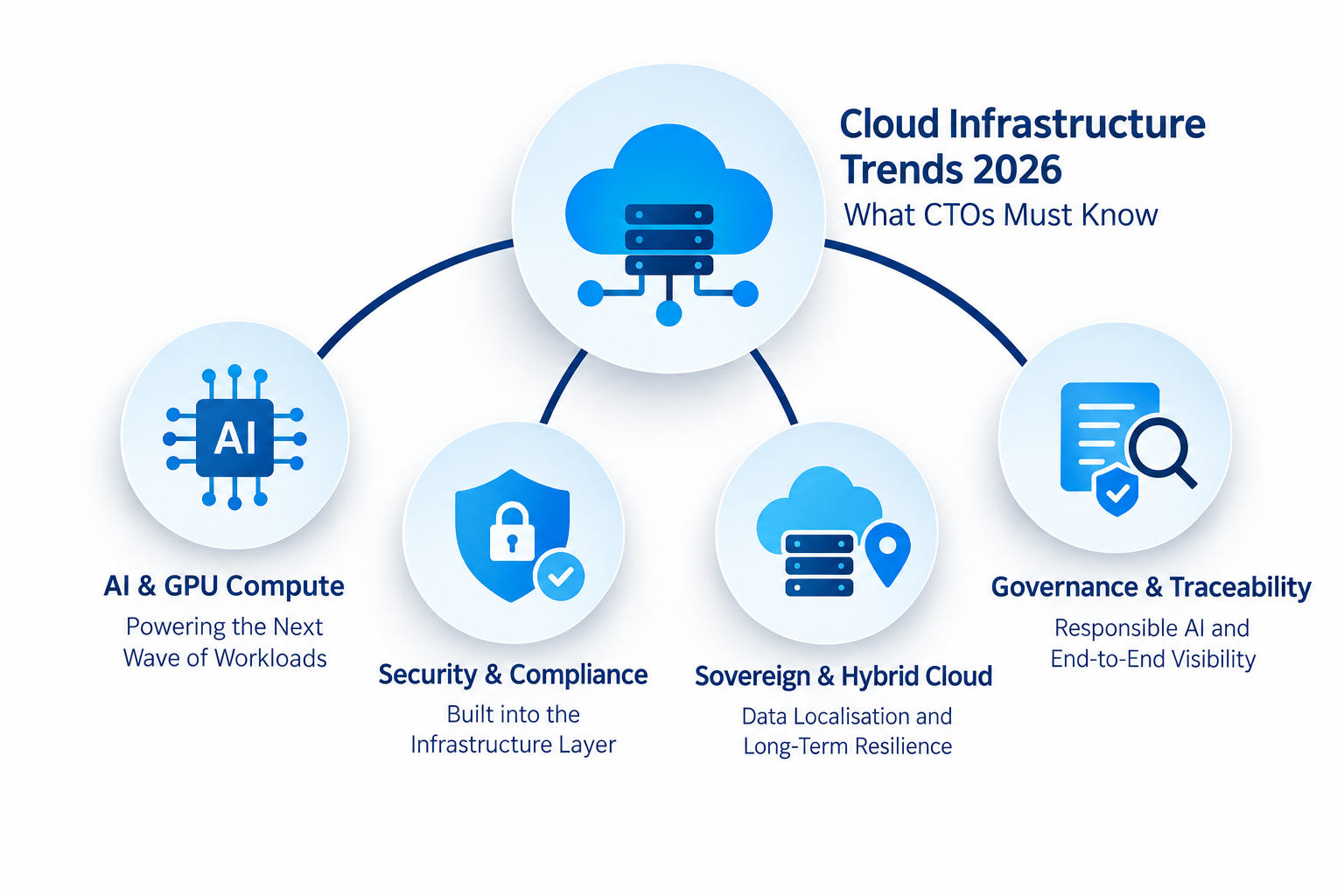
Cloud infrastructure trends 2026 are pushing enterprise technology leaders far beyond the old priorities of uptime and cost savings. As organisations across India accelerate their digital maturity, cloud platforms are being judged on a very different set of criteria: how well they support intelligent workloads, meet regulatory expectations, and remain resilient under growing scrutiny. For CTOs, this shift means infrastructure decisions can no longer be made in isolation from governance, security, and compliance conversations.
Below is a practical look at the forces reshaping enterprise cloud strategy this year.
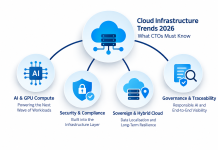
Why AI Is Redefining Infrastructure Baselines
Supporting artificial intelligence is no longer an optional add-on for enterprise cloud environments, it’s becoming a default expectation. Modern infrastructure needs to comfortably handle accelerated compute, large-scale data pipelines, and orchestration for both training and inference workloads. Sectors like banking, healthcare, and government are particularly affected, since AI models in these spaces frequently interact with sensitive or tightly regulated data.
Closely tied to this is the rising role of GPU-based compute. What was once confined to research teams is now spreading into everyday enterprise use, powering analytics, automation, and simulation tasks. This growth is forcing infrastructure teams to rethink power density, cooling design, and consumption-based pricing models to keep pace.
Security and Compliance Move to the Infrastructure Layer
Protecting data is no longer just about encryption at rest or in transit. Confidential computing is gaining traction across financial services, healthcare, and government. It protects data while it is being processed. Hardware-backed trusted execution environments help meet strict privacy and security requirements.
Cybersecurity itself is also becoming more anticipatory. Rather than reacting to breaches after they happen, infrastructure platforms are embedding security telemetry and automated response systems directly into the stack, enabling risk-based controls before incidents escalate.
As AI adoption deepens, a new category of risk has emerged too, things like prompt manipulation and unauthorised model access. This is pushing CTOs to evaluate dedicated AI security platforms and check that their infrastructure can actually support these controls, whether the AI systems are built in-house or sourced from third parties.
Sovereign and Hybrid Cloud Become Long-Term Strategy
Hybrid and sovereign cloud models are no longer temporary steps toward full cloud adoption. They are becoming permanent architectural choices. For Indian enterprises, sovereign cloud can help meet data localisation and jurisdictional requirements. It also provides the scalability of cloud computing.
This same logic is driving a broader trend of relocating regulated workloads away from global hyperscale environments toward regional or national infrastructure, reducing exposure to cross-border regulatory and geopolitical risk.
Governance, Traceability, and Specialised AI Deployments
Two related trends are also shaping how infrastructure is built: domain-specific AI models and digital provenance. Enterprises increasingly train AI on industry-specific data to boost accuracy and compliance, often deploying these models closer to the data source for latency or governance reasons, which naturally pushes adoption toward private, hybrid, or sovereign environments.
Meanwhile, digital provenance, the ability to trace the origin of data, software components, and AI-generated outputs, is becoming essential for audit readiness. Infrastructure platforms are adapting to support the metadata management and logging this traceability requires.
Finally, as businesses lean more heavily on interconnected AI agents performing tasks across multiple systems, infrastructure needs to support reliable orchestration, secure APIs, and cross-platform visibility, reshaping how networking and monitoring are designed.
Conclusion
Taken together, these cloud infrastructure trends for 2026 point to a clear direction. Infrastructure planning is no longer just a technical exercise. It is also a governance and risk management function. CTOs should build AI readiness, data sovereignty, and embedded security into their infrastructure from the start. This approach can help enterprises scale confidently while staying compliant with India’s evolving regulatory landscape.